Helping people access support, information, and care when they need it.
Our interdisciplinary research develops and evaluates conversational artificial intelligence (AI) tools that connect people with health information, services, and ongoing
support. We study how chatbots can extend the reach of care teams while remaining trustworthy, inclusive, safe, and firmly connected to human care.
WHAT WE DO
|
Connect Help people find reliable information, services, and members of their care team. |
Support Offer timely check-ins, reminders, referrals, and coaching between human contacts. |
Learn Use community-engaged research to evaluate usability, trust, safety, and real-world impact. |
FEATURED CHATBOT: SUZY (SCREENSHOT SHOWN)
Suzy began as a collaboration led by Dimagi with UCLA and Harvard/Massachusetts General Hospital to develop remote substance use screening and follow-up support for prima
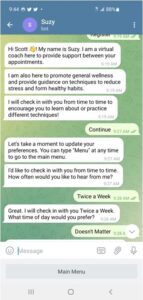
ry care patients. The project produced Suzy, a chatbot designed to provide recovery-oriented support such as craving-management strategies, appointment reminders, referrals, care-team contacts, and goal setting.
The project used a multiphase, human-centered process. Patients and health professionals helped define chatbot functions; patients then completed usability testing of a rule-based prototype; and the team subsequently developed a more conversational large language model version with input from peer recovery coaches and substance use experts. Afterwards, the research team conducted a pilot study with 55 patients in substance use recovery treatment to evaluate changes in substance use, mental health and quality of life after having access to Suzy over 12-weeks. Findings are forthcoming in a peer-reviewed publication.
FUTURE DIRECTIONS
We are developing a broader research program focused on safe, useful, and human-centered conversational AI to assist health professionals in improving the mental and physical health of their patients. Future work may include:
- Multilingual and culturally responsive chatbots designed with communities that have historically faced barriers to care.
- Safety systems that detect urgent needs, limit inappropriate advice, and route people to qualified human support.
- Real-world studies of engagement, equity, implementation, clinical outcomes, cost, and effects on workforce burden.
PUBLICATIONS
Suzy and substance use recovery
Comulada WS, Swendeman D, Ho YX, Streck JM, Lewis DM, Rezai R, Warren D, Pachas G, Chandler M, Jackson JL, Gelberg L. Development, Feasibility, Acceptability, and Usability of an Artificial Intelligence-Powered Chatbot (Suzy) to Support Patients in Substance Use Disorder Recovery: Multiphase Study. JMIR Formative Research. 2026;10:e84683. doi:10.2196/84683.
TelePrEP chatbot development
Braddock WRT, Ocasio MA, Comulada WS, Mandani J, Fernandez MI. Increasing Participation in a TelePrEP Program for Sexual and Gender Minority Adolescents and Young Adults in Louisiana: Protocol for an SMS Text Messaging-Based Chatbot. JMIR Research Protocols. 2023;12:e42983. doi:10.2196/42983.
Stakeholder perspectives
Comulada WS, Rezai R, Sumstine S, Flores DD, Kerin T, Ocasio MA, Swendeman D, Fernandez MI, Adolescent Trials Network CARES Team. A necessary conversation to develop chatbots for HIV studies: qualitative findings from research staff, community advisory board members, and study participants. AIDS Care. 2024;36(4). doi:10.1080/09540121.2023.2216926.
https://doi.org/10.1080/09540121.2023.2216926
HIV chatbot research landscape
van Heerden A, Bosman S, Swendeman D, Comulada WS. Chatbots for HIV Prevention and Care: a Narrative Review. Current HIV/AIDS Reports. 2023;20(6):481-486. doi:10.1007/s11904-023-00681-x.
https://doi.org/10.1007/s11904-023-00681-x
COLLABORATE WITH US
We welcome collaborations with community organizations, clinicians, peer and behavioral health professionals, public health programs, researchers, and technology partners interested in developing and evaluating responsible AI chatbots for health and wellness.
Contact: Dr. W. Scott Comulada at wcomulada@mednet.ucla.edu.